Part-Time Diplomas

TBA
TBA
900 Hours (2.5 years)
Face-to-Face (Classroom Teaching)
Class Schedule
3 evenings during weekdays, 6.30pm and 10.30pm
Please refer to the Academic Calendar.
For SBS Transit and SMRT Corporation staff, please click here to register.
Enquiries
For course specific details, please contact the course manager:
For other enquiries, please email to [email protected].
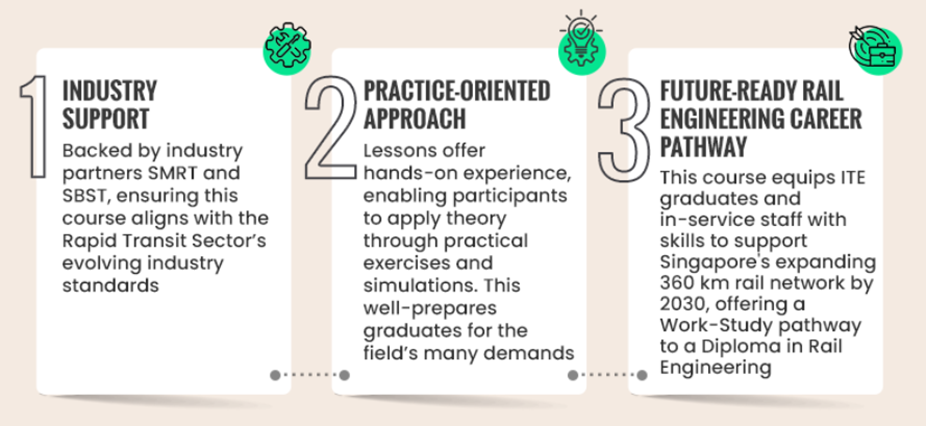
This is a 2.5-year part-time course consisting of 5 Modular Certificates conducted over 5 semesters.
| Modular Certificate | Key Modules |
|---|---|
| MC 1 - Electrical & Electronic Engineering | - Electrical Principles - Digital Principles |
| MC 2 - Technologies for Rail Engineering | - Engineering Data Analytics & Industrial Internet of Things - Engineering Asset Management & Operation Technology |
| MC 3 - Rapid Transit Technology | - Rapid Transit Signalling System - Rapid Transit Technology (Application) |
| MC 4 - Fundamental Technical Training* | - Rail Systems Maintenance I - Workplace Safety & Health I - Rail Operation - Maintenance Management |
| MC 5 - Advanced Rapid Transit Technology* | - Rail Systems Maintenance II - Workplace Safety & Health II - Process Improvement & Business Management - Critical Core Skills (Leadership) |
| MC 6 - Automation & Electrical Installation | - PLC Applications - Electrical Installation Design |
| MC 7 - Networks & Smart Sensors & Actuators | - Networks & Protocols - Smart Sensors & Actuators |
This Diploma is offered through two distinct pathways - for SBS/SMRT employees and members of the public. For more information, please click here for the module synopsis. Modules 4 and 5 are exclusively conducted for SBS/SMRT employees.
Local Universities After completing this course, you can explore further studies opportunities with local universities such as:
|

Singapore Polytechnic
500 Dover Rd Singapore 139651