

Are you curious about how computers work, and do you enjoy working with technology? If you’re analytical, detail-oriented, and curious about computer systems, the Diploma in Computer Engineering is for you. Tailored for those who prefer practical, experiential learning. You’ll engage in hands-on activities in advanced labs, working with real hardware and software. Start your journey in computer engineering at SP today.
In addition, you will graduate with a Minor upon the completion of a suite of related elective modules. SP offers 6 Minors for you to choose from:

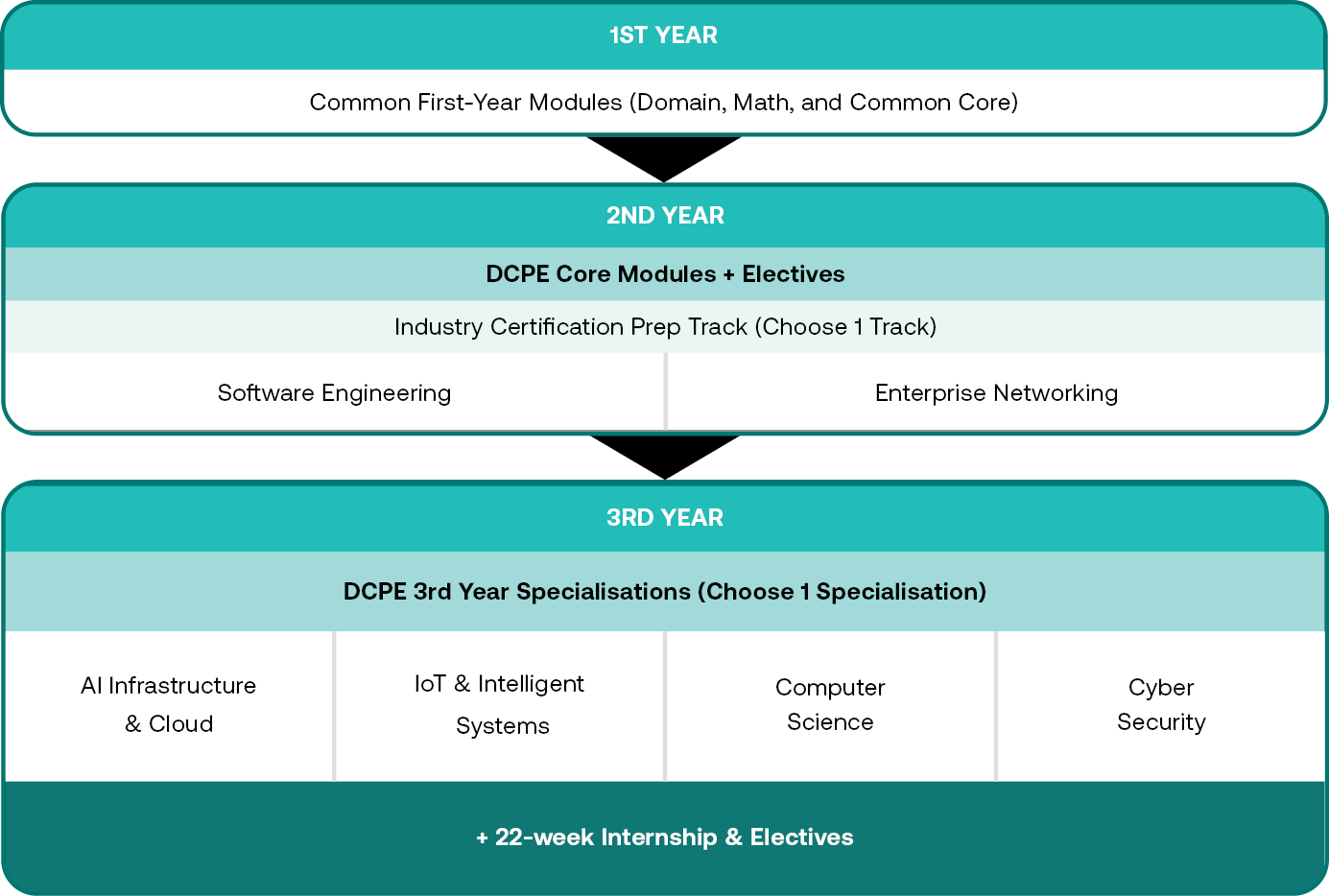
DCPE is a three-year programme that takes you from the fundamentals of computer engineering to a specialisation of your choice. In Year 1, you will build a strong foundation in core computer engineering concepts. In Year 2, you will deepen your computer engineering skills across AI, cloud, hardware, and software, and choose an Industry Certification Prep Track that prepares you for a globally recognised industry certification. In Year 3, you can specialise in one of four fields: AI Infrastructure & Cloud, IoT & Intelligent Systems, Computer Science, or Cyber Security. No matter which track you choose in Year 2, all four specialisations remain open to you.
Beyond your computer engineering core modules, the SP elective framework gives you the freedom to pursue your passions and meet different career needs, forming an integral part of your holistic education at SP.
Learn about SP Elective Framework
The Common Core Curriculum (CCC) prepares you for a future shaped by AI, rapid change, and real-world challenges. Across seven modules, you will build AI and digital skills, while developing critical human skills such as teamwork, critical thinking, creativity, and communication. These skills will help you stand out at the workplace and in life. You will also engage with challenges that matter to Singapore, ASEAN, and the world through the Sustainable Development Goals (SDGs), gain a deeper understanding of how they affect different communities, and discover how you can contribute to a more sustainable future.
Learn about Common Core Curriculum
Please note: Course structure is subject to change.
Building Foundations in Computer Engineering and Essential Skills
In Year 1, you will start with the basics of computer engineering. You’ll learn key concepts, common practices, and important terminologies through modules like Principles of Electrical and Electronic Engineering, Digital Electronics, Network Fundamentals, Basic and Engineering Mathematics. These modules will introduce you to essential software and hardware skills.
Strengthen Your Computer Engineering Core and Choose Your Certification Track
In Year 2, you'll deepen your computer engineering skills across AI, cloud, hardware, and software, building the core competencies every modern computer engineer needs. You'll then choose an Industry Certification Prep Track aligned to your interests. Either track keeps all four Year 3 specialisations open to you.
You will also begin your electives and participate in the Sustainable Innovation Project (SIP), where you will tackle real-world problems through creative and innovative thinking. This year is designed to deepen your knowledge and prepare you for internships and the professional world.
In Year 3, you’ll apply your knowledge through an internship, gaining hands-on experience in the industry.
Regardless of which track you completed in Year 2, you can specialise in AI Infrastructure & Cloud, IoT & Intelligent Systems, Computer Science, or Cyber Security.
By the end of Year 3, you’ll be a confident graduate ready to enter the industry.

What are the eligibility requirements for computer engineering?
Applicants should not be suffering from severe vision deficiency, acute hearing impairment or uncontrolled epilepsy. Interested applicants with any of these conditions are advised to contact Singapore Polytechnic for more information.
You must meet the following criteria to qualify for the Diploma in Computer Engineering:
This course is perfect if you're analytical, love challenges, and think critically. It's ideal for those who are detail-oriented, process-focused, and curious. Computer engineering enhances your problem-solving skills and creativity, preparing you to tackle complex tech challenges and innovate in real-world environments.
One significant advantage of DCPE is that it keeps your options open. DCPE doesn't limit your future career or further studies to software-only opportunities, instead preparing you for diverse roles across the entire technology spectrum. The programme covers eight cutting-edge technology areas: 5G Technology and Applications, Artificial Intelligence, Internet of Things, Cloud Computing, Software and DevOps, Embedded Systems, Cyber Security, and Computer Networking. This breadth ensures you gain foundational knowledge across hardware, software, systems, and security domains.
If you enjoy understanding how technology works across different domains and want flexibility in the rapidly evolving tech landscape, computer engineering could be your ideal path forward.
SP offers many scholarships to recognise talent and service, from Year 0 to after graduation. These scholarships provide tuition fee waivers and chances to represent SP. They are awarded for academic excellence, contributions to arts or sports, and community service. Edusave awards and external sponsorships are also available.
Click here to find the full list of scholarships available
Other than the day-to-day classroom learning which includes engaging group discussions, insightful lectures and tutorials, and doing projects, SP provides many opportunities for you to socialise with friends, and participate in co-curricular activities that enhance your skills. Imagine gaining new knowledge daily, supported by peers who share your passion!
Check out the activities that a Computer Engineering student can participate in like exciting hands-on lessons, memorable industry projects and internships, and more!


Computer engineering at SP prepares me for the future.
Excelling in computer engineering requires hands-on learning. At SP, you’ll find amazing laboratories that let you build foundational skills in Digital Electronics, Electrical and Electronics, and Digital Fabrication. The Network Security Operation Lab trains you to tackle cybersecurity threats, while the Data Analytics Lab focuses on big data and visualisation tools. Explore IoT in the SMART Connected Solutions Lab and work on real-world projects in AI, smart devices, and more at the 5G & AIoT Hub. These facilities ensure that you're fully prepared for the tech industry.
Computer engineering at SP prepares me for Singapore.
Computer engineering is important because it powers everyday technology. In 2026, advancements in AI and 5G are transforming industries. However, cyber threats are becoming increasingly pervasive. DCPE equips you with the knowledge to understand these technologies and address cyber threats, preparing you for the future. Many people think it's just about coding, but it also includes hardware and designing systems that change how we live and work.
Computer engineering at SP prepares me for the world.
In computer engineering, you can specialise in several fields. At SP, these include:
Each specialisation provides thorough training so that you’re prepared for advanced roles in the tech industry.
SP provides 22-week internships at various organisations, including startups, SMEs, MNCs, and government agencies. Students have interned at leading organisations like Equinix (Singapore) Enterprises Pte Ltd, Singapore Technologies Engineering Ltd, NCS Pte Ltd, Singapore Telecommunications Limited, and the Centre for Strategic Infocomm Technologies.
These internships allow you to make significant contributions and often lead to advanced job offers. They provide insights into different business environments and help you decide if this field suits you. Some interns move on to full-time roles like Data Centre Operation Technicians, laying a solid career foundation.
Internships connect you with industry professionals, offering job insights and opportunities. SP supports with coaching to boost your confidence and employability. Experiencing diverse internships broadens your career perspective, leading to informed decisions, higher starting salaries, and business exposure. A quality internship provides meaningful work, learning opportunities, professional growth, and guidance from mentors.
Overseas exposure helps broaden your horizons. Understanding globalisation and working with diverse cultures is important in a global city like Singapore. Computer engineering students and alumni have experienced international internships and exchanges, enriching their worldviews and career prospects. Students in other CCAs also have opportunities to represent Singapore abroad and gain international experience.


SP EEE diploma graduates can apply for NUS Computer Science degrees with additional exemptions.
If you’re preparing for university and want to make the most of your diploma time, an SP diploma can let you fast-track your education by 0.5-2 years!

Improve your career with globally recognised certificates in computer engineering. These certificates keep you updated with the latest in cloud computing, networking, programming, and security.
The DCPE course is aligned with globally recognised certificates. Our students can access learning resources and hands-on experiences that support the development of industry-relevant and career-ready skills.
Supported by: AWS Academy
Supported by: Cisco Networking Academy
During my internship at A*STAR’s (I²R) Cybersecurity department, I worked on a web application project with cloud security, gaining hands-on experience with advanced techniques and programming languages. Beyond academics, I led school events and contributed to student clubs and volunteer initiatives. These experiences have fostered my passion for cybersecurity and motivated me to further enhance my skills in the field.

With the advent of smart cities across the globe, SP’s DCPE course has rapidly evolved its content and extra-curricular opportunities to include highly sought-after skills in computing, such as IoT, Machine Learning, AI, Block Chain and Cloud Computing. Armed with these fundamental know-hows, I was able to perform at my engineering internships at Grab and the Centre for Strategic Infocomm Technologies. With our training, I have great faith that my DCPE cohort will do great things for our nation and beyond.

As a DCPE student at Singapore Polytechnic, my journey extended far beyond academics — leading grassroots and overseas projects and participating in various competitions gave me invaluable perspectives on community development and cross-cultural collaboration. During my internship at A*STAR's Institute for Infocomm Research (I2R), I worked in the Machine Intellection department on generating synthetic semiconductor data, co-authored a conference paper, and tackled complex computational challenges. Together, these experiences have driven my passion for using engineering to make a lasting difference in people's lives.

Singapore Polytechnic’s DCPE program provided a strong foundation with technical skills and soft skills like systems thinking and resilience. This prepared me for Cambridge University, where I earned the British Petroleum scholarship. SP’s supportive environment and curriculum helped me excel academically and gain a global perspective, enabling a seamless pivot to finance, where I applied engineering expertise to add value in investment banking and private equity.

The DCPE course provided a strong technical foundation. I had opportunities to pursue renowned industry certifications. Competitions and internships enabled me to stay at the forefront of technologies and innovate solutions to address real-world issues. Through leadership programmes, I learnt to leverage technology to foster policy development. As Chairperson of the DCPE-DEEE Graduation Party, I put these into practice by implementing a QR code ticketing system, streamlining registration and significantly enhancing operational efficiency for almost 300 attendees.

I completed my internship locally at Centre for Strategic Infocomm Technologies (CSIT). As an intern in the Software Engineering department, I worked on a fullstack development project and explored various technology stacks. It was a fulfilling and memorable experience as I could learn new, modern technology stacks that enabled me to build on the foundations of my existing knowledge in software development. I also had the opportunity to interact with my mentors and staff at CSIT, who were knowledgeable and helpful, giving me an insight into the working environment at CSIT. This experience has helped to shape my current aspirations and solidified my interests.



Singapore Polytechnic
500 Dover Rd Singapore 139651
